Clapham’s deep shelters: why they were built and what they do now
Three of London’s eight deep shelters sit under Clapham, and one of them still runs guided tours.
By Clapham London Editorial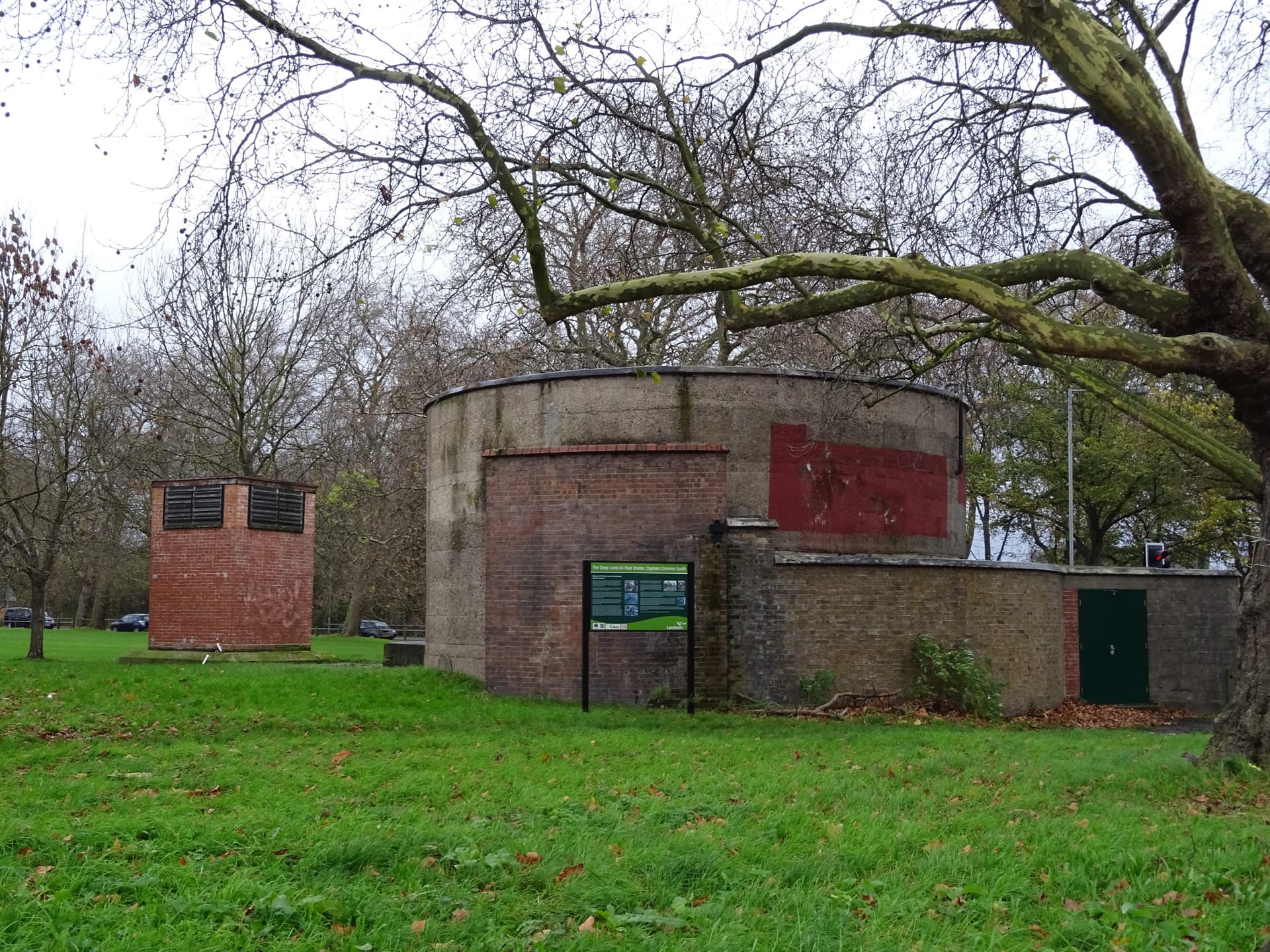
Three of London’s eight wartime deep-level shelters are under Clapham: Clapham North, Clapham Common and Clapham South. You can see the circular entrances above ground, but only Clapham South has been open to visitors, through guided tours run by London Transport Museum. Check the museum’s Hidden London page before you plan anything.
Why they were built
The Blitz of 1940 forced the government to rethink its shelter policy. According to the Subterranea Britannica page on Clapham South, at the end of October 1940 it decided to build deep shelters linked to existing tube stations.
Ten were planned and eight were built. Anderson Shelters lists the eight as Belsize Park, Camden Town, Goodge Street, Chancery Lane, Stockwell, Clapham North, Clapham Common and Clapham South. Each was meant to hold up to 8,000 people.
The design was two parallel tubes, each 16 ft 6 in across and 1,600 ft long, dug beneath the existing running tunnels and linked to the stations above. Londonist describes how they were also designed so they could later be joined up as an express tube line after the war.
Too late for the Blitz
The shelters were not finished until after the worst of the bombing. The Clapham Society says the first complete shelter was ready in March 1942, and Clapham South and Clapham North were fitted out and handed over on 21 October 1942, with Clapham Common ready by the end of that month. Bombing had fallen away and the Ministry of Home Security was reluctant to open them to the public.
The Society says Stockwell, Clapham North and Clapham South opened to the public in July 1944. Final closure was on 7 May 1945.
Clapham South: Windrush and the tours
The north entrance is on the Common, at the junction of Clapham Common South Side, Nightingale Lane and The Avenue, SW4. It is the best known of the three because of 1948. The Empire Windrush reached Tilbury with 492 migrants from Jamaica, and with no accommodation available, the Colonial Office housed many of them in the Clapham South shelter. Wikipedia puts the number at around 200, while The Voice says about 236.
The nearest labour exchange was on Coldharbour Lane, which the Subterranea Britannica page says led the arrivals to Brixton.
The shelter was later used by thrifty visitors to the Festival of Britain in 1951, and then for archive storage. It is now Grade II listed. London Transport Museum’s Hidden London programme has run pre-booked guided tours since 2016. According to the museum, the tour covers almost a mile of tunnels, about 11 storeys down, with historic graffiti and reconstructed areas.
Prices, dates and availability change, so check the museum’s page directly. Clapham South tube is on the Northern line, and TfL is worth checking on the day.
Clapham Common: from archive to farm
The north entrance is behind hoardings on Clapham High Street, SW4, at the junction with Carpenters Place. It is a circular concrete pillbox with a brick ventilation shaft. A marker on the site says it was built in 1942 and used as a troop hostel and for government purposes, then for archive storage from 1990 to 2015.
After that came Growing Underground, a hydroponic farm founded by Steven Dring and Richard Ballard, growing herbs, micro-greens and salad leaves under LED lights about 33 m below Clapham. Londonist tells how Dring spotted a to-let sign after the pair had first looked at disused office blocks. The farm’s first trials were at Clapham North in 2015, and it moved to Clapham Common because restoring the Clapham North lift was not cost-effective, according to Subterranea Britannica.
Growing Underground was never open to the public beyond occasional tours, and Unreasonable Group now lists it as no longer operating.
Clapham North
The Clapham North shelter is at Clapham High Street and Clapham Road. The Clapham Society ran a visit there in 2006, and Subterranea Britannica records that the tunnels were once advertised to let as about 60,000 sq ft of underground storage. It also hosted the farm’s early trials.
What to do
- Book a Hidden London tour of Clapham South if you want to go underground.
- Walk the Common’s South Side to see the Clapham South drum entrance.
- Look for the Clapham Common entrance on Clapham High Street, but expect hoardings and no access.